
–
–
Microfluidic components
for life science
–
–
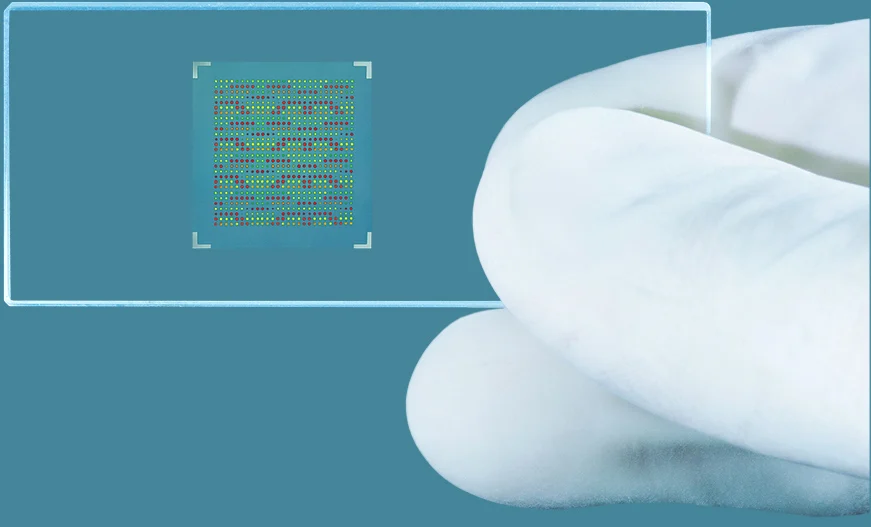
PLANOPTIK develops and manufactures customized microfluidic chips and microstructured components made of glass, quartz, silicon and glass-silicon combinations for life science applications, including lab-on-chip, organ-on-chip and advanced cell-based microfluidic systems.
We support customers from feasibility assessment and prototyping to repeatable series production, combining precision microstructuring, optical functionality and application-specific fluidic design.
Application fields:
– MEDICAL SOLUTIONS
– PHARMACEUTICAL APPLICATIONS
– DIAGNOSTICS
– BIOTECHNOLOGY
– ANALYTICAL APPLICATIONS
– LABORATORY APPLICATIONS

Little Things Factory is a brand of PLANOPTIK.
–
–
Microfluidic chips
–
–
Microfluidic chips enable the precise transport, control and processing of very small liquid volumes within microchannels, chambers and functional structures. They form the technological basis for a wide range of applications in life science, diagnostics, biotechnology and pharmaceutical research.
PLANOPTIK develops and manufactures customized microfluidic chips made of glass, quartz, silicon and glass-silicon combinations. Depending on the application, precisely defined microchannels, cavities, through-holes, fluidic interfaces, optical areas and bonded multilayer structures can be integrated into the device.
–
–
Lab-on-chip
–
–
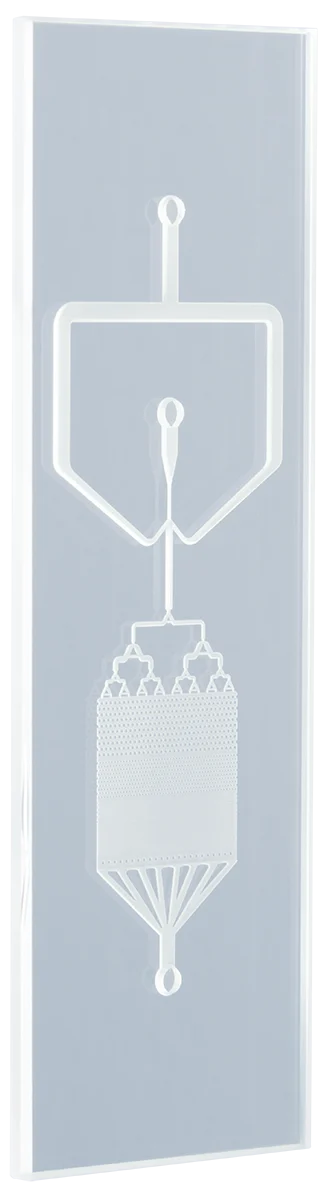
Lab-on-chip technology integrates laboratory functions such as sample handling, mixing, reaction, separation or analysis into compact microfluidic devices. This can reduce sample and reagent consumption while enabling precisely controlled and reproducible analytical workflows.
Customized microfluidic components are made of glass, quartz and silicon with precisely defined channels, chambers, through-holes and fluidic interfaces. The high optical transparency and chemical resistance of these materials make them particularly suitable for demanding analytical, diagnostic and biological applications.
Typical applications:
- Point-of-care and molecular diagnostics
- Sample preparation and biochemical assays
- Miniaturized analytical and laboratory systems
–
–
Cell encapsulation
–
–
Cell encapsulation uses microfluidic processes to enclose individual cells or defined cell populations within droplets, hydrogels or other controlled microenvironments. Precise and reproducible droplet generation enables highly controlled encapsulation processes and defined conditions for subsequent biological analysis or cultivation.
We manufacture precision microfluidic chips with customized channel geometries and junction designs for controlled droplet generation and encapsulation workflows. Flow-focusing, cross-flow and application-specific microfluidic structures can be adapted to the required flow conditions, droplet characteristics and process requirements.
Typical applications:
- Single-cell encapsulation and analysis
- Cell-loaded hydrogel and microgel generation
- High-throughput biological screening and assays
–
–
Droplet generation with microstructured glass chips
Flow-focusing and cross-flow geometries enable controlled and reproducible droplet generation for cell encapsulation and other microfluidic workflows.

–
–
Organ-on-chip
–
–
Organ-on-chip platforms use controlled microfluidic environments to reproduce selected physiological conditions for cell and tissue culture. Defined fluid flow, biochemical stimuli and controlled microenvironments can be used to create advanced in-vitro models for biomedical and pharmaceutical research.
PLANOPTIK develops and manufactures customized microfluidic components for organ-on-chip platforms. Precisely defined microchannels and culture chambers can be combined with optical access, chemically resistant materials, fluidic interfaces and bonded glass structures tailored to the individual device concept.
Typical applications:
- Drug efficacy and toxicity screening
- Disease modelling and personalized medicine research
- Advanced in-vitro tissue and organ models

–
–
Optofluidics
–
–
Optofluidics combines controlled microfluidic dispensing with optical observation, detection or manipulation. At the same time, precisely designed microfluidic structures can guide, separate, position or analyze particles, cells and optical measurements like transmission and refractive measurements within defined fluid flows.
Our microfluidic components made of glass and quartz have high optical transparency, precisely defined channels and application-specific structures. This combination enables fluidic control and optical analysis to be integrated within the same device.
Typical applications:
- Fluorescence and optical detection
- Cell and particle sorting or positioning
- Microscopy-based particle and cell characterization

–
–
Drug delivery
–
–
Drug delivery technologies are designed to deliver pharmaceutical substances in a controlled, efficient and reproducible manner. Microstructured components and precision nozzles can influence droplet size, spray characteristics, dosage and liquid distribution and therefore play an important role in advanced drug delivery systems.
PLANOPTIK’s micro nozzles are made of glass or glass-silicon combinations with customized geometries for pharmaceutical and medical applications. Wafer-based microstructuring, bonding and dicing enable highly reproducible component geometries and scalable production from development to series manufacturing.
Typical applications:
- Soft-mist inhalers
- Pharmaceutical aerosol and spray generation
- Microneedle-based drug delivery systems
–
–
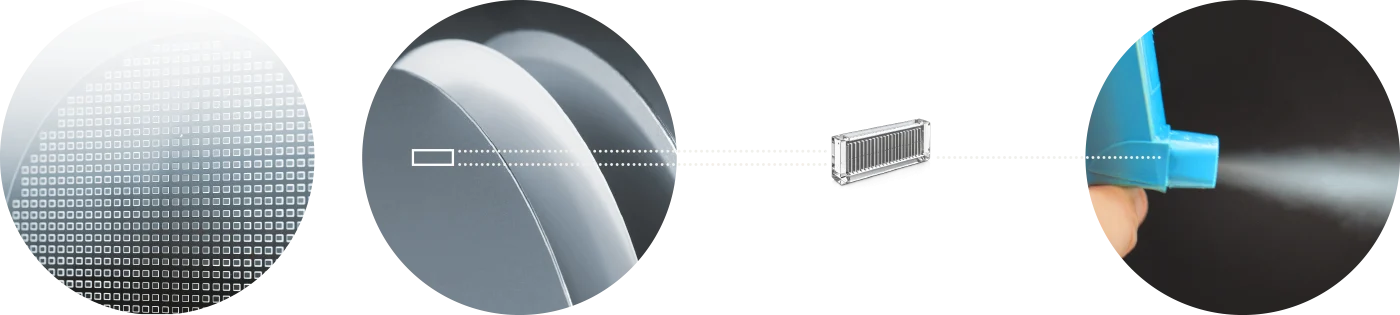
How wafers are turned into microcomponents for soft mist inhalers
–
–
Wafer Microstructuring
Glass or glass-silicon wafers are processed with thousands of precisely defined microstructures using application-specific microfabrication technologies.
–
–
Wafer bonding
Structured wafers are aligned and permanently bonded to create the required functional microstructures and fluidic interfaces.
–
–
Microcomponent after wafer dicing
The processed wafer stack is diced into individual precision microcomponents.
–
–
Integration into the final device
The finished microcomponents are integrated into the customer-specific drug delivery system.
–
–
Key advantages of glass
in life science
–
–

Low
Fluorescence
Bio
compatibel
Long term
stable
Optical
transparency
Chemical
resistance
Heat
resistance
High mixing
intensity
UV
transmission

Cost
effective!
No hurdles
when upscaling!
–
–
Meet with PLANOPTIK
–
–
Microfluidics Event
SLAS
Conference & Exhibition
Meet us to explore customized microfluidic chips and components for applications like lab-on-chip, organ-on-chip, diagnostics, droplet microfluidics, particle handling and optofluidics. Our capabilities range from precise microchannels, cavities, and through-holes to optical windows, bonded assemblies and many more. We accompany your device development all the way from prototype to series production. Let’s talk about your next microfluidic project. We look forward to seeing you in San Diego!
Showcase products
> Components for life science
> Microsystems for flow chemistry

Meet PLANOPTIK at
Booth #553
Contact
Alexander Schilling
+49 2664 5068 34
[email protected]
Website
Organizer
Society for Laboratory Automation and Screening
Microfluidics Event
Flow Chemistry Europe
Conference & Exhibition
…Event details to follow…
Showcase products
> Microsystems for flow chemistry
> Components for life science

Date
April 14 – 16, 2027
Venue
Malaga, Spain
Meet PLANOPTIK at
Booth #16
Contact
Alexander Schilling
+49 2664 5068 34
[email protected]
Website
Organizer
Flow Chemistry Society
Microfluidics Event
Achema
Exhibition
…Event details to follow…
Showcase products
> Microsystems for flow chemistry
> Components for life science

Meet PLANOPTIK at
Booth number to follow
Contact
Alexander Schilling
+49 2664 5068 34
[email protected]
Website
Organizer
Dechema
–
–
Your personal advisor


–
–
Team up with PLANOPTIK
–
–

–
–
Individually developed
Are you developing a new microsystem? Are you combining microelectronics, micromechanics or microfluidics to create a new product? Are you developing a sensor, an electronic device, a fluidic system or something that has never existed before? Team up with PLANOPTIK.
–
–
Reliable partnership
In us you will find a partner who will work with you to develop electronic, mechanical, optical, chemical or biological microcomponents and has a firm grasp of materials such as glass, silicon and copper.
–
–
Together until production
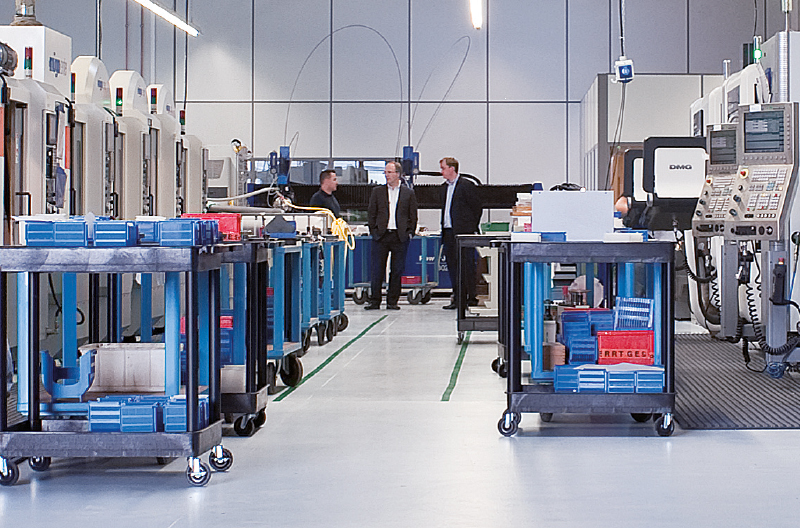
PLANOPTIK also manufactures the jointly developed microcomponents and elements in high volumes using state-of-the-art wafer-based manufacturing processes.